
Chapter 2: Oceans and Continents Class 6 Notes are provided here to help students understand the key concepts easily. We have covered all the important points from the NCERT textbook in a simple and clear way. These notes will assist students in quick revision and better preparation for exams. Along with the notes, answer keys, and related study resources are also available on ExamKeeda to give students complete support in learning this chapter.
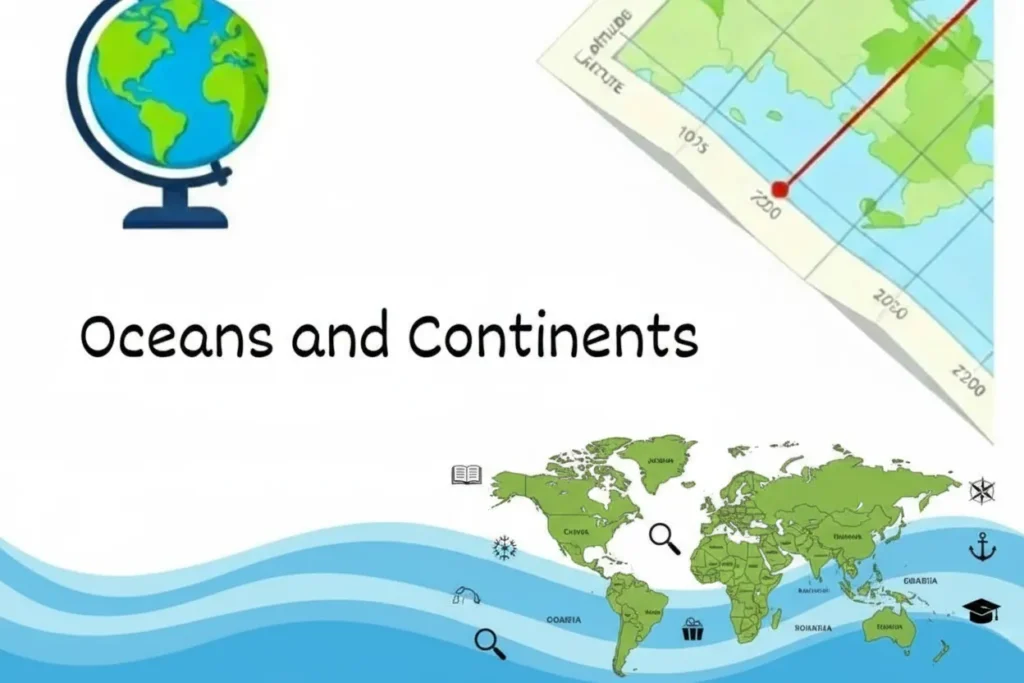
Oceans and Continents
Take a look at Earth from space. What do you see? Mostly blue! That’s because about three-fourths of the Earth’s surface is covered by water — the oceans. The remaining part is land, made up of large landmasses called continents. Both oceans and continents shape the climate of our planet and influence all living things, including us. From the rain we depend on to the air we breathe, oceans and continents play a vital role in our everyday lives.
What are Oceans?
Oceans are vast bodies of saltwater that cover most of Earth. There are five main oceans: Pacific, Atlantic, Indian, Southern, and Arctic. Oceans regulate the climate, support diverse marine life like fish, whales, and algae, and bring rainfall to the land.
What are Continents?
Continents are large expanses of land surrounded by oceans. There are seven continents: Asia, Africa, North America, South America, Europe, Australia, and Antarctica. Each continent has unique animals, plants, environments, and cultures.
Important Facts
- Oceans cover nearly 75% of Earth’s surface.
- Asia is the largest continent, and Australia is the smallest.
- Ocean plants called algae produce more than half of the Earth’s oxygen.
- More land is found in the Northern Hemisphere compared to the Southern Hemisphere.
Do You Know?
- The emblem of the Indian Navy contains the motto Sam noh Varunah, which means “Be auspicious to us, O Varuna”. Varuna is a Vedic deity associated with oceans, water, and sky.
- Earth’s largest island is Greenland — it is bigger than the combined area of India’s ten largest states!
- The oceans are interconnected and not separated by true physical boundaries; the lines on maps that divide them are merely conventions.
- The largest ocean is the Pacific Ocean, followed by the Atlantic Ocean and the Indian Ocean. The smallest is the Arctic Ocean.
- Tsunamis are huge waves caused by underwater earthquakes or volcanic eruptions. The 2004 Indian Ocean tsunami caused widespread damage and loss of life in multiple countries, including India.
- Oceans produce half of the world’s oxygen and support the water cycle that brings rain to continents. They are called the “lungs of the planet.”
- Human activities like pollution and overfishing threaten marine life and ocean health. Protection of oceans is essential for our survival.
Protecting Our Planet
Pollution, excessive fishing, and climate change are harming the oceans and land. Taking care of these natural resources is essential for the health of the Earth and all its living beings.
Read Also-:
CH1 – The Wonderful World of Science Class 6 Notes
